
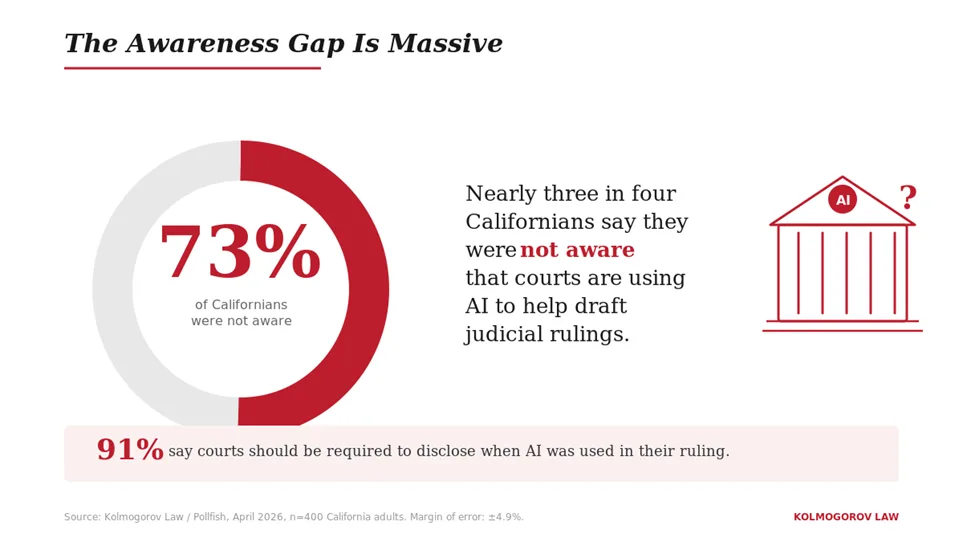
A new survey finds 73 percent of Californians are unaware that courts are using AI to help draft rulings, while 91 percent say judges should be required to disclose it
IRVINE, Calif., April 2026
THE SHIFT NOBODY IS TALKING ABOUT
California courts have begun using artificial intelligence to summarize legal filings and draft tentative rulings in civil cases. The largest trial court in the nation — Los Angeles Superior Court — launched a pilot program in March 2026, giving civil court judges access to AI software that distills hundreds of pages of filings and produces draft tentative rulings. Similar programs are now running in at least ten states. Over 60 percent of surveyed judges nationally report having used AI in their work, according to an April 2026 Washington Post investigation.
For litigants whose disputes are processed through these courts, the practical effect is concrete: AI is now the first reader of the brief their attorney filed. In many California departments, tentative rulings posted under California Rules of Court, rule 3.1308, are adopted without modification unless a party specifically requests oral argument. If AI drafted that tentative, AI functionally drafted the ruling.
But the people on the receiving end of these rulings — overwhelmingly — do not know this is happening.
WHAT 400 CALIFORNIANS TOLD US
A survey of 400 California adults age 25 and older, conducted April 17, 2026, through the Pollfish research platform, found that 73 percent of respondents were not aware that California courts are using AI software to help judges summarize legal filings and draft tentative rulings. (Pollfish survey, Q2; n=400; margin of error ±4.9 percent at 95 percent confidence.) The remaining 27 percent reported awareness.
Among the 34.5 percent of respondents who reported prior involvement in a California lawsuit — as plaintiff, defendant, or both (Pollfish survey, Q1) — the awareness gap persisted at comparable levels. The people most likely to have their cases affected by judicial AI were no better informed about its existence than those who had never set foot in a courthouse.
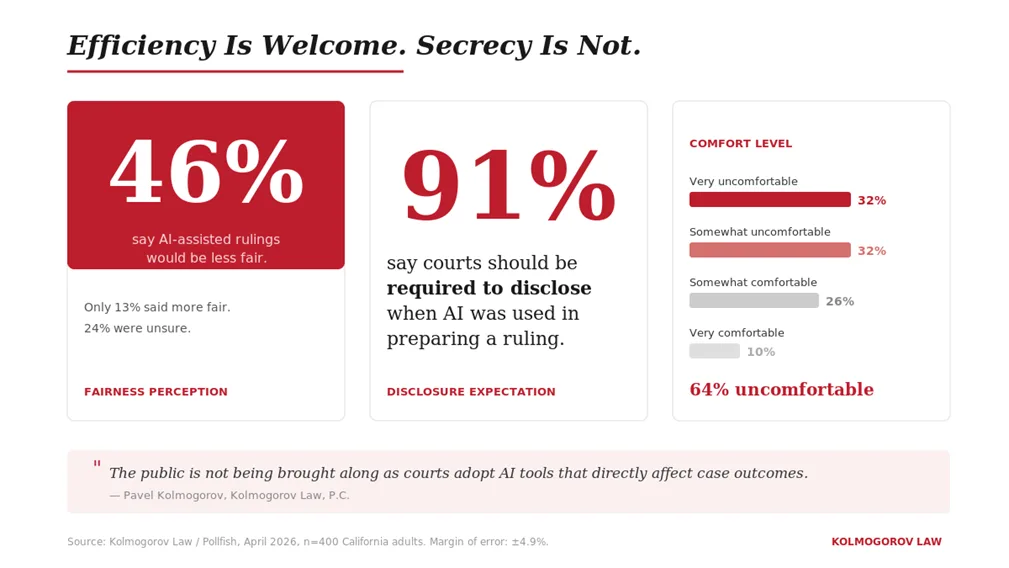
The discomfort is equally pronounced. When asked how comfortable they would be if AI software assisted a judge in summarizing filings and drafting a tentative ruling in a lawsuit involving their business, 64 percent of respondents said they would be uncomfortable — 32 percent somewhat uncomfortable, 32 percent very uncomfortable. (Pollfish survey, Q3.) Only 10 percent reported being very comfortable.
The disclosure finding was the strongest in the survey. Ninety-one percent of respondents said courts should be required to disclose to the parties when AI was used in preparing a ruling in their case. (Pollfish survey, Q4.) Just 4.5 percent said disclosure should not be required, and 4.5 percent were unsure. That is not a contested question. It is near-unanimous.
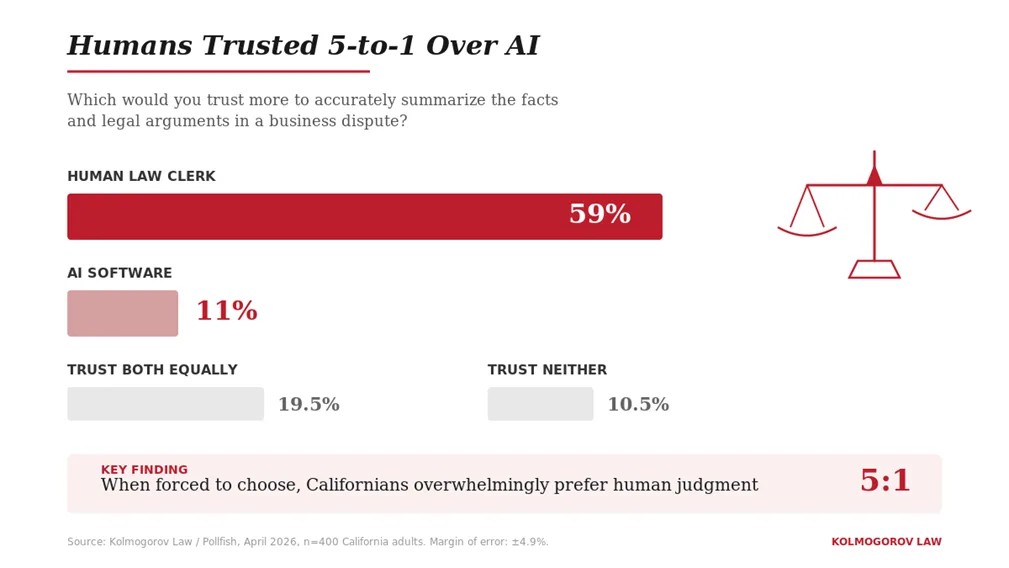
On trust, respondents favored human judgment by a five-to-one margin. Fifty-nine percent said they would trust a human law clerk working for the judge to accurately summarize the facts and legal arguments in a business dispute, compared to 11 percent who said they would trust AI software designed for judicial case preparation. (Pollfish survey, Q5.) Another 19.5 percent said they would trust both equally, and 10.5 percent said they would trust neither — meaning that when forced to choose between human and machine, the public is not close to divided.
On fairness, 46 percent of respondents said they believe AI-assisted judicial rulings would be less fair than rulings made entirely by a judge and human staff. (Pollfish survey, Q6.) Only 13 percent said AI rulings would be more fair, 17 percent said equally fair, and 24 percent were unsure. Nearly half the public, in other words, believes that the technology courts are quietly adopting will make outcomes worse.
THE LEGAL FRAMEWORK — AND THE GAP IN IT
California is ahead of most states on regulation. The Judicial Council adopted California Rules of Court, rule 10.430 on July 18, 2025, effective September 1, 2025 — the nation's first statewide judicial AI framework. (Cal. Rules of Court, rule 10.430.) The rule requires courts that permit AI use to adopt local generative AI policies, imposes data privacy protections, and mandates human oversight.
But rule 10.430 contains a critical limitation and a critical gap. The limitation: judges are not authorized to use AI to “draft legal opinions.” (Cal. Rules of Court, rule 10.430.) The gap: the rule's disclosure obligation applies only when court-generated content is “entirely” AI-produced. A workflow in which AI generates a draft that a judge then reviews and edits — which is precisely how current pilot programs operate — may never trigger that threshold.
The question that follows is straightforward. Under California Rules of Court, rule 3.1308, tentative rulings in civil cases are functionally dispositive. They are posted the day before the hearing and adopted unless a party requests oral argument. In practice, most litigants treat the tentative as the ruling. If AI drafted the tentative, and the judge adopted it with minor edits, was the result a “legal opinion” within the meaning of rule 10.430? If so, the pilot programs may be operating outside the rule. If not, the framework has a gap wide enough to drive a docket through.
The due process dimension is equally unresolved. No California rule currently guarantees a litigant the right to know whether AI participated in preparing a ruling in their case. No federal rule does either. Among the ten or more states where court systems have adopted AI judicial preparation tools, none has established a mandatory disclosure requirement triggered by the use of AI in individual case rulings.
The self-represented litigant problem compounds the concern. As AI-assisted legal filing tools become more common among pro se litigants, a growing number of cases will involve AI-generated filings being processed by AI-powered judicial preparation software. In that scenario, the human judge becomes a reviewer of AI-to-AI work product — a dynamic that California's current framework does not contemplate and that 91 percent of the public, according to this survey, would want to know about.
SURVEY METHODOLOGY
This article is based on a survey of 400 California adults age 25 and older conducted April 17, 2026, through the Pollfish online research platform. The survey included six substantive questions covering awareness of AI use in California courts, comfort with AI-assisted judicial rulings, disclosure expectations, trust in human versus AI case preparation, and fairness perceptions. The margin of error for the full sample is approximately plus or minus 4.9 percent at a 95 percent confidence level. The survey did not include screening questions; respondents represent the general adult population of California.
SOURCES
Survey data: Kolmogorov Law / Pollfish, April 17, 2026, n=400 California adults. Legal framework: California Rules of Court, rules 3.1308, 10.430; Standards of Judicial Administration, standard 10.80 (Judicial Council of Cal., adopted July 18, 2025, eff. Sept. 1, 2025). LA County pilot: Governing.com, March 2026; Morningstar/Business Wire, March 18, 2026. Multi-state adoption and judicial usage statistics: Washington Post, April 2, 2026. Federal AI errors: Washington Times, October 2025; Justia, 2025.

Comments
There are no comments for this post. Be the first and Add your Comment below.
Leave a Comment